
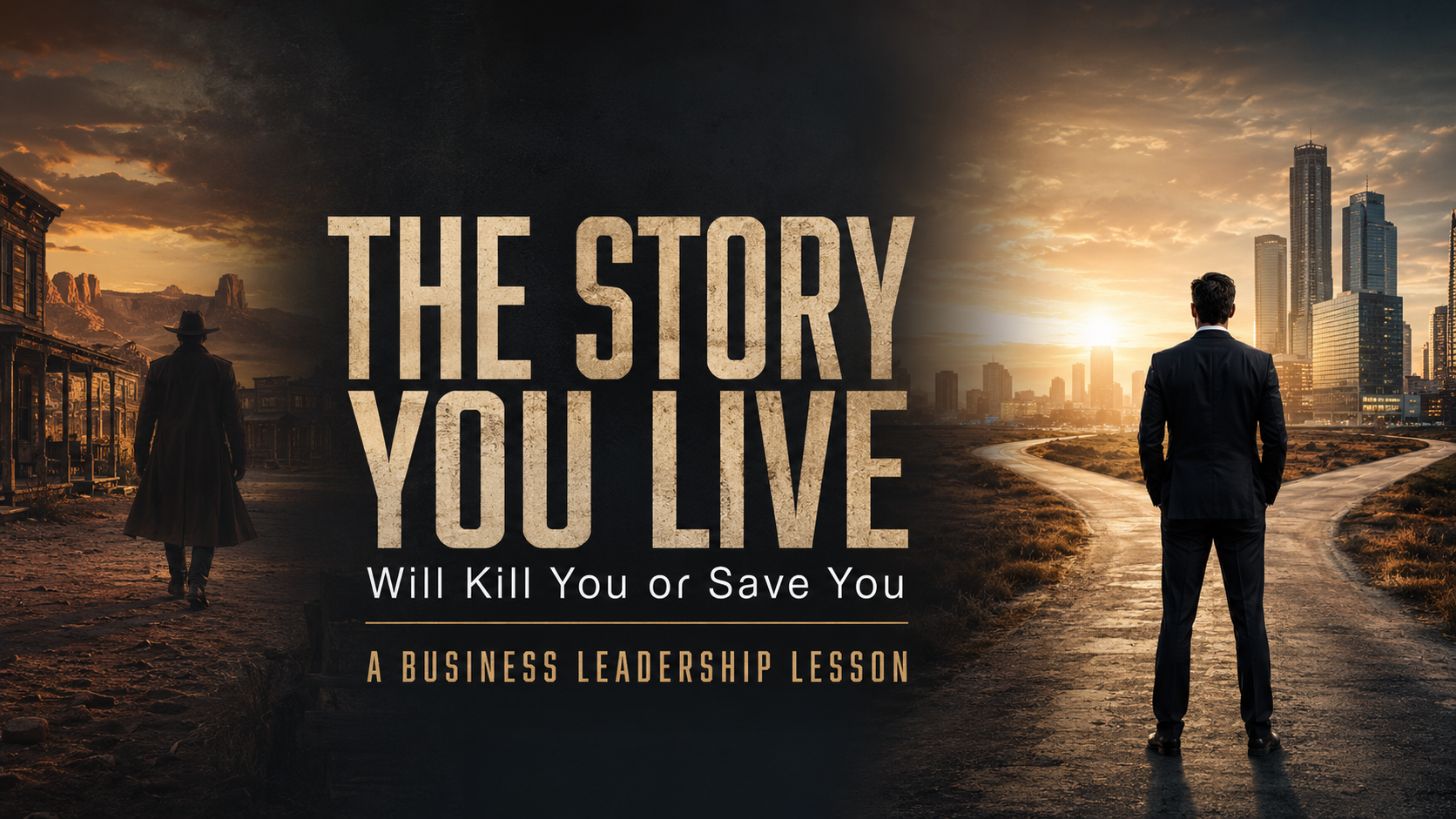
The Story You Believe About Yourself Is Shaping Your Business
Every business owner lives by a story.
It is the story you believe about who you are, what you are capable of, what you deserve, and what is possible for your future. That internal story influences the risks you take, the opportunities you recognize, the people you trust, and the way you respond when business becomes difficult.
The trouble is that the story directing your decisions may not be true.
In Episode 672 of the terrywilson3.com Podcast, “The Tombstone Lesson: The Story You Live Will Kill You or Save You,” I sit down with clinical addiction specialist Jeff Wells to explore the psychology behind the characters in the classic Western film Tombstone.
Although our conversation begins with a movie, the real subject is much larger. It is about identity, pride, addiction, loyalty, purpose, and the stories people repeatedly tell themselves.
For entrepreneurs and small business owners, those lessons are especially important. The greatest obstacle standing between you and the next level of your business may not be your competition, the economy, technology, or a lack of opportunity. It may be the story you have accepted about yourself.
Your Business Will Rarely Outgrow Your Identity
Business owners spend a great deal of time thinking about marketing, sales, pricing, staffing, customer service, lead generation, and technology. Those things matter, but they are all influenced by something deeper: the identity of the person making the decisions.
If you see yourself as someone who is always behind, every setback will appear to confirm that story.
If you believe you are not good at selling, you will avoid the conversations that could grow your company.
If you think technology is too complicated for you, you will resist tools that could save time and improve your marketing.
If your identity depends on always being right, you will have difficulty receiving coaching, correcting mistakes, or changing direction.
If you believe your past has permanently determined your future, you may stop pursuing opportunities before you ever discover what is possible.
These beliefs eventually become business behaviors. Business behaviors become patterns. Those patterns become results—and those results appear to validate the original story.
That is how a false narrative can quietly become a self-fulfilling prophecy.
The Difference Between Pride and Purpose
One of the most revealing contrasts in Tombstone is the difference between Johnny Ringo and Doc Holliday. Both men are intelligent, talented, wounded, and deeply flawed. But they relate to their brokenness in very different ways.
Ringo represents a person trapped inside a destructive identity. His pain becomes part of the image he protects. His intelligence serves his ego rather than freeing him from it. Instead of confronting the story controlling him, he continues living it until that story carries him toward destruction.
Doc Holliday is also broken, but he possesses something Ringo lacks: awareness. He recognizes his condition. He understands his limitations. Most importantly, he finds meaning through loyalty, relationship, and a purpose larger than himself.
This difference matters in business.
Pride asks, “How do I protect the image I have created?”
Purpose asks, “What must I become to fulfill the responsibility in front of me?”
Pride hides weaknesses. Purpose confronts them.
Pride interprets correction as an insult. Purpose sees correction as an opportunity.
Pride keeps repeating familiar patterns because change would require admitting that something is not working. Purpose is willing to change strategies while remaining committed to the mission.
A business owner controlled by pride will often defend the very habits preventing growth. A business owner driven by purpose can evaluate those habits honestly and make a better decision.
Five Destructive Stories Business Owners Must Challenge
1. “I Have to Do Everything Myself”
Many entrepreneurs begin by handling every part of the business. In the early stages, that may be necessary. Eventually, however, self-reliance can become a bottleneck.
If every decision, customer interaction, marketing task, and follow-up effort depends on you, the business does not truly have a system. It has an exhausted owner.
Growth often requires better processes, automation, delegation, and trusted guidance. Learning to receive help is not weakness. It is leadership.
2. “Marketing Just Does Not Work for My Business”
When a campaign does not immediately produce results, it is easy to decide that marketing itself does not work. But one unsuccessful message, platform, or promotion does not define what is possible.
The real problem may be unclear positioning, inconsistent follow-up, the wrong audience, a weak offer, or a lack of repetition. Effective marketing requires testing, measurement, and adjustment.
The better story is not, “Marketing does not work for me.” It is, “I have not yet discovered the right message, system, or strategy for this market.”
3. “My Market Is Too Crowded”
Competition is real, especially for service businesses throughout Spartanburg, Greenville, and the surrounding Upstate South Carolina market. But competition also proves that people are actively purchasing the service you provide.
You do not have to be the only business offering a particular service. You need to communicate clearly why the right customer should choose you.
Your experience, values, personality, specialization, service model, and approach can create meaningful differentiation when presented effectively.
4. “My Past Results Prove What My Future Will Be”
A failed promotion, lost client, poor hiring decision, or unsuccessful business venture can teach valuable lessons. It should not be allowed to become your permanent identity.
Failure is information. It can reveal what needs to be strengthened, changed, or abandoned. But when failure becomes a personal label, it begins influencing every future decision.
The question is not whether you have made mistakes. Every business owner has. The question is whether you will repeat the story or apply the lesson.
5. “This Is Just the Way I Am”
This may be the most limiting story of all.
Business owners sometimes use personality as permission to avoid necessary growth:
- “I am not a salesperson.”
- “I am not good with people.”
- “I am not creative.”
- “I cannot understand technology.”
- “I have never been organized.”
You may naturally be stronger in some areas than others, but your current comfort zone does not have to become your permanent boundary. Skills can be learned. Systems can compensate for weaknesses. Technology can simplify difficult tasks. Coaching can expose blind spots and help you develop a clearer strategy.
Your Internal Story Becomes Your External Message
The story a business owner believes does not remain private. It eventually appears in the company’s marketing and culture.
Uncertainty produces confusing offers. Fear creates timid messaging. Desperation leads to poor pricing decisions. Pride prevents the company from listening to customers. A scarcity mindset causes the owner to chase every prospect rather than serving the right audience.
Conversely, a clear sense of identity produces confident communication. When you understand whom you serve, what problem you solve, and why your work matters, your marketing becomes more focused.
This is one reason good business coaching involves more than tactics. Tactics are valuable, but a new marketing tool placed in the hands of someone operating from an old, destructive story may simply help that person repeat the same patterns faster.
Real growth requires both practical systems and personal clarity.
How Business Owners Can Begin Writing a Better Story
Changing your story does not mean pretending challenges do not exist or repeating empty motivational phrases. It means examining the beliefs driving your behavior and replacing false assumptions with truth, evidence, responsibility, and purposeful action.
- Identify the recurring statement. What do you repeatedly say about yourself, your customers, your industry, or your potential?
- Examine the evidence. Is that statement objectively true, or has it become an explanation that protects you from risk and change?
- Recognize the resulting behavior. What action—or inaction—does this belief produce?
- Choose a more accurate story. Replace the limiting belief with a truthful statement that leaves room for learning, responsibility, and growth.
- Support the new story with action. Make one decision that is consistent with the business owner and leader you are becoming.
A healthier story might sound like this:
“I may not know everything required to reach the next level, but I can learn, receive guidance, use the right tools, and take the next responsible step.”
That kind of statement is not fantasy. It is a practical commitment to growth.
A Valuable Leadership Conversation for Upstate Business Owners
Small business owners and entrepreneurs throughout Spartanburg, Greenville, the Upstate of South Carolina, and Western North Carolina face real pressures. Markets change. Technology advances. Customer expectations increase. Competition becomes more sophisticated.
But external changes do not automatically determine your outcome. Your ability to interpret those changes, adapt your strategy, and lead with clarity will have an enormous effect on what happens next.
That is why the conversation in Episode 672 is valuable for business owners, sales professionals, entrepreneurs, managers, and organizational leaders. It challenges us to examine the internal narratives behind our external decisions.
Listen to Episode 672: “The Tombstone Lesson—The Story You Live Will Kill You or Save You.”
As you listen, do not simply analyze Doc Holliday or Johnny Ringo. Ask yourself a more personal question:
What story am I living, and where is it taking my business?
Move From Insight to Implementation
Recognizing a destructive pattern is important, but awareness alone does not create change. Business owners need a practical plan, the right tools, honest feedback, and support that helps turn insight into measurable action.
Through TW3, I help entrepreneurs and small business owners improve their positioning, generate leads, strengthen marketing, implement automation, use AI effectively, and create more predictable systems for growth. My coaching, consulting, and speaking work combines personal development with practical business implementation because sustainable success requires both.
If you are a business owner in Spartanburg, Greenville, Upstate South Carolina, Western North Carolina, or anywhere across the country, explore these resources:
- Business coaching for Spartanburg and Upstate South Carolina entrepreneurs
- Small business coaching with Terry Wilson and TW3
- Invite Terry Wilson to speak at your business, organization, conference, or leadership event
- Explore TW3 business tools, consulting, marketing services, and growth resources
Your current story may explain where you are, but it does not have to determine where you finish.
Choose the story that calls you forward—and then build the habits, relationships, tools, and systems required to live it.
Ready to Grow Your Business?
Discover the marketing systems, AI tools, lead generation strategies, automation resources, and business coaching programs available through TW3.
Whether you need more leads, better follow-up, AI-powered marketing, or a clearer growth strategy, our Start Here page will point you in the right direction.
