What if your next great hire didn’t have to start with a job posting—or a hiring emergency? In this episode, Terry Wilson explores why business owners, managers, and organizational leaders should keep building relationships with talented people and stay alert to the skills their organizations will need next.
“Always recruiting” doesn’t mean always hiring. It means understanding your future capability needs, getting to know people in your field, and being prepared to make thoughtful talent decisions before urgency takes over. AI can help with research, preparation, and follow-up, while people remain responsible for fair, evidence-based hiring decisions.
In this episode
Why waiting until someone leaves can narrow your hiring choices
How ongoing talent conversations can reveal future skill gaps
Why recruiting also includes developing and retaining the people already on your team
How to define a role around real work and outcomes
Why structured interviews and job-related evidence are more useful than hiring by “vibe”
Practical ways AI can help organize recruiting without making hiring decisions for you
A manageable weekly recruiting rhythm and a 30-day plan to get started
Key takeaways
Always recruiting is not always hiring. It is a steady practice of learning about talent and preparing for future needs.
Start with the work. Define the outcomes, skills, and responsibilities before looking for a candidate.
Build relationships before you need them. Be transparent about whether a role exists, and make conversations useful for both sides.
Use frameworks thoughtfully. Personality or work-style tools should not replace job-related evidence or be treated as a guarantee of success.
Let AI assist the process. Use it to prepare questions, organize follow-ups, and clarify skill needs; keep people accountable for evaluating candidates and making decisions.
A simple way to begin
Choose one business outcome that matters over the next year.
Identify the skills or capabilities needed to achieve it.
Talk with one person who understands that work. Ask what is changing and what excellent performance looks like.
Use what you learn to decide whether to develop someone internally, redesign the work, bring in temporary expertise, or hire.
Research and further reading
CIPD: Talent management — An overview of attracting, identifying, developing, engaging, retaining, and deploying talent.
What capability will our organization need most in the next 12 months?
Where are we relying too heavily on one person’s knowledge or skills?
Could we develop someone already on the team before recruiting externally?
Are our interview questions tied to the actual work and applied consistently?
How could we use AI to reduce administrative effort while keeping hiring decisions accountable and human-led?
Always recruiting doesn’t mean filling a calendar with interviews. It means staying curious, building respectful relationships, and making better talent decisions before the pressure is on.
Better thinking needs a practical way forward. Terry Wilson explains how connecting leadership, communication, and mindset with business systems can help turn insight into action.
How to Lead, Serve, and Grow Without Losing Your Foundation
Part 1 of Built to Last in a Changing World
How do you build a business people trust when customers are cautious, technology keeps changing, and the pressure to succeed follows you home?
In episode 689, we connect current stories about consumer confidence, small-business artificial intelligence adoption, and seasonal spending to the decisions you make every day. We explore how to explain your value, use new tools responsibly, keep your promises, and pursue growth without losing sight of the people and priorities that matter most.
The question running through this conversation is simple: How do you stay true to your purpose when the conditions keep changing?
Read the Room Before You Push for a Decision
A hesitant customer may need more information, a clearer explanation, or time to weigh competing responsibilities. Before assuming someone does not value your work, ask whether they understand your offer.
We discuss how to separate facts from fears, lead a team through a slower month, and give people a useful next step when the outlook feels uncertain.
A question to consider: Where have you mistaken confusion for rejection?
Make Your Value Easier to Understand
People can be careful with their budgets and still make room for purchases and experiences they value. Your responsibility is to help them understand what you offer, what it includes, and what they can reasonably expect.
Try completing this sentence: I help this kind of person address this problem through this specific service. Then explain the process and what the customer will need to do.
An honest offer respects the buyer’s judgment. Clear promises, accurate testimonials, and straightforward pricing help close the gap between what you think you sold and what someone thinks they bought.
Give AI a Specific Job—and Keep Human Accountability
Trying a new tool is easy. Improving a piece of work takes more thought. Start with a repeated task you understand, define a good result, and decide how a person will check the output.
In this episode, we explore a simple follow-up example: a consistent intake process, a useful template, and an AI-assisted draft reviewed for accuracy before it reaches a customer.
The principle: The tool can assist the work; the responsibility remains with the person. Convenience does not transfer accountability.
Put Your Values Into Your Procedures
Trust grows through ordinary promises kept consistently. If responsiveness matters, assign someone to each inquiry. If accuracy matters, decide who checks the work. If fairness matters, give your team a clear way to address complaints.
We also discuss what makes a speaker or leadership message useful: a recognizable problem, an understandable principle, and a practical response people can carry into Monday morning.
A question to consider: What promise have you left hanging?
Give Your Ambition a Foundation
Growth brings opportunity and responsibility. Your convictions deserve a voice before your plans become commitments.
We look at the value of wise counsel, humility about tomorrow, and rhythms that protect family, reflection, and community. For listeners whose faith anchors their lives, these are familiar principles with everyday applications: steward what you have been entrusted with, treat people as neighbors, and leave room for gratitude.
Your worth has a deeper foundation than your latest result. That perspective makes it easier to receive correction, ask for help, and examine a setback honestly.
Your Seven-Day Action Plan
Seek clarity. Separate the facts from your fears and identify one responsible next step.
Listen. Ask someone you serve what is making a decision difficult. Give them room to answer.
Improve one promise. Clarify an offer, proposal, service description, or invitation.
Improve one repeated task. Choose a practical change and define how you will know whether it helped.
Close a gap in trust. Send the overdue update, correct a mistake, or follow through on a commitment.
Serve without calculating the return. Encourage someone, share useful knowledge, or make a welcome introduction.
Review and give thanks. Recognize what you learned, who helped, and what needs attention next week.
Carry the Conversation Forward
If you lead a company, business association, church group, or conference, consider what your people need right now: practical instruction, encouragement that takes their challenges seriously, and leadership worthy of their trust. To explore bringing this message to your group, use the contact information associated with this podcast.
Share this episode with someone who is navigating change, building a business, or carrying the responsibility of leadership. Tell them which idea made you think of their situation.
Coming next:A Business People Can Trust—a closer look at the journey from the first promise through the follow-through.
Sources and Further Reading
News references researched as of October 23, 2026. Survey findings describe their respondents; spending projections reflect intentions rather than completed sales. The practical applications in this episode are commentary, not guarantees of business results.
Goldman Sachs: AI Survey and Methodology—86% of surveyed program alumni reported using AI, while 15% reported fully integrating it into core operations. These results describe program alumni, not all American small businesses.
688 - You Don’t Need More Leads: The Follow-Up System That Finds Hidden Revenue
/
RSS Feed
Share
Link
Embed
The TW3 Podcast · Episode 688
You Don’t Need More Leads
Before you spend more money chasing strangers, learn how to restart unfinished conversations and uncover the revenue already hiding in your contact list.
When sales slow down, most business owners immediately reach for the same solution: We need more leads.
Sometimes that is true. But before you increase the advertising budget, launch another campaign, or start chasing a brand-new audience, there is a better question to ask:
How many people have already shown interest in what you do—but never received the right follow-up?
Your next customer may not be a stranger. That person may already be in your phone, inbox, CRM, social-media messages, or stack of old estimates. They know your name. They understand at least part of your offer. At some point, they raised their hand.
The conversation simply stopped.
In Episode 688 of the TW3 Podcast, I share a straightforward way to reopen those conversations without cold calling, pressuring people, or sending canned messages that sound like they came from a robot. I call it the TW3 Follow-Up Five.
Find hidden opportunityIdentify the warm relationships that deserve another conversation.
Follow up with valueReplace pressure and awkward pitches with helpful, human communication.
Create a systemUse practical automation so valuable opportunities stop falling through the cracks.
The expensive assumption behind a sales slowdown
Lead generation matters. Every healthy business needs a reliable way to meet new prospective customers. But generating more leads will not repair a broken follow-up process.
If ten people enter your pipeline and eight of them are forgotten after the first interaction, sending twenty more people into that same system only creates a larger pile of missed opportunities. It is like pouring more water into a bucket without first repairing the hole.
Why this matters right now:
In its August 2026 Small Business Economic Trends report, the NFIB found that the net percentage of owners reporting higher nominal sales fell to −9%, the weakest reading since November 2025. When sales become harder to produce, the quality of your follow-up becomes even more valuable.
This is not an argument against marketing. It is an argument for getting more value from the marketing you have already done.
If your business needs a stronger system at the front of the pipeline, TW3 offers practical lead generation services for small businesses. But before you buy more attention, make sure you are properly serving the attention you already earned.
Four places hidden revenue tends to accumulate
Most businesses have more warm opportunities than they realize. Start by looking in these four places:
Undecided prospects: People who requested information, a quote, or a consultation but never made a final decision.
Former customers: People who already trust you but have not heard from you in months—or years.
Unfinished referrals: Introductions that were appreciated but never developed into a meaningful conversation.
Missed inquiries: Voicemails, messages, form submissions, and social comments that arrived during a busy day and received little or no response.
None of these people should be treated like names on a list. They are real people who had a reason to connect with your business. Good follow-up is not about squeezing money out of a database. It is about finding out who still has a problem you may be able to solve.
You do not need a complicated campaign to begin. You need a clear process you can repeat.
Sort
Divide your contacts into three simple groups: former customers, undecided prospects, and referral partners. Different relationships deserve different conversations.
Select
Choose 25 people who are most likely to benefit from hearing from you now. Do not hide behind a list of 2,500 names. Start with 25 human beings.
Serve
Lead with something useful: an answer, an update, a new resource, a relevant introduction, or an observation that applies to their situation.
Start
Ask one easy, honest question that makes a reply natural. The immediate goal is not to close a sale. The goal is to restart the conversation.
Schedule
When someone expresses a need or interest, make the next step simple. Offer a short phone call, consultation, demonstration, or appointment.
What should you say to an old lead?
You do not need a clever sales script. In fact, trying to sound clever is often what makes follow-up uncomfortable. Be direct, helpful, and personal.
A simple reactivation message
“Hey [Name], I was reviewing some earlier conversations and thought about you. When we last spoke, you were working on [goal or problem]. Is that something you are still trying to solve, or has your direction changed?”
That message works because it does not pretend the previous conversation never happened. It shows that you remember the person, gives them permission to say their situation changed, and opens the door without pushing them through it.
If you can include a resource genuinely connected to their need, even better. Service builds trust. Pressure usually destroys it.
Use AI to create leverage—not distance
Artificial intelligence and automation can make this process faster, but they should not make it less human.
AI can help you categorize contacts, summarize earlier conversations, draft several message options, identify common questions, and remind you when a personal response is needed. Automation can send confirmations, appointment reminders, nurture content, and scheduled check-ins.
But technology should support the relationship—not impersonate one.
Federal Reserve research shared in June 2026 found that nearly half of small employer firms were using AI in some capacity, and 71% of those firms reported increased productivity. The advantage is not merely having access to AI. The advantage comes from applying it to a real business process that saves time or improves service.
Do not automate a message you would not send personally
Before putting any follow-up into a workflow, read it aloud and ask:
Does this sound like something I would actually say?
Does it acknowledge the person’s needs—or only mine?
Does it make the next step clear and easy?
Would I feel respected if I received it?
Automation magnifies whatever you put into it. A thoughtful message becomes consistent service. A selfish message becomes consistent irritation.
Put Episode 688 into action
The 48-Hour Revenue Recovery Challenge
Export or review your contacts from the past 12–24 months.
Circle 25 people who previously showed real interest or trust.
Write one personal sentence about what mattered to each person.
Send a short, service-first message and ask one simple question.
Respond personally to every reply and invite the right people to a brief conversation.
25
personal contacts
5
real conversations
2
appointments to pursue
Why this approach works
Trust is one of the most expensive things to build in business. With a warm contact, some degree of trust already exists. They may have met you, heard you, bought from you, been referred to you, or taken enough interest to ask a question.
Your follow-up does not have to manufacture attention from nothing. It simply has to reconnect their earlier interest with the problem they may still want to solve.
That is why the next sale may not be hiding in a new advertising campaign. It may be sitting inside a conversation you never finished.
TW3 helps business owners connect strategy, practical coaching, lead generation, AI tools, and automation so good opportunities stop falling through the cracks.
Now I would like to hear from you: How many unfinished sales conversations do you think are sitting in your contact list right now? Leave a comment below—and then choose the first five people you are going to contact.
You Cannot Market Your Way Out of a Broken Business Model
Sometimes the biggest problem in a business is not the marketing, management, technology, or staff. Sometimes the business itself is built around a contradiction.
When a business struggles, we usually blame the most visible thing.
We say it needs a better website, more leads, stronger content, a new sales funnel, better technology, more automation, a different manager, or another employee.
Sometimes one of those things really is the problem. But sometimes improving them only helps the business execute the wrong idea more efficiently.
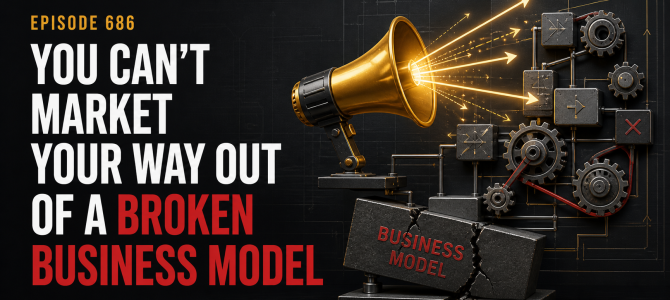
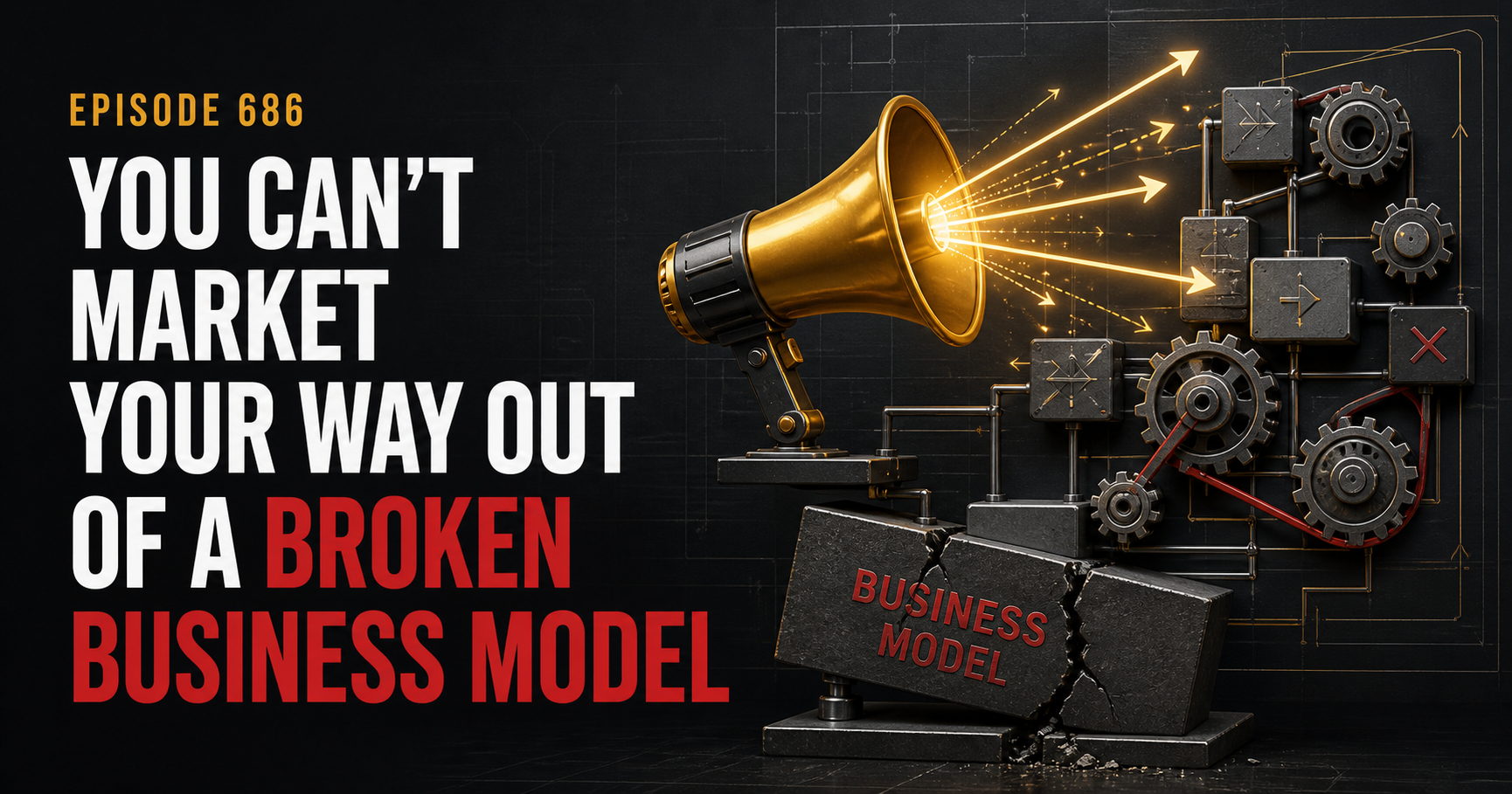
That is the subject of Episode 686 of the TerryWilson3.com Podcast: the difference between a marketing problem and a business-model problem.
In This Episode
Why better marketing can expose a weak business model faster
How a company can contradict the very result it promises
Why targeting the wrong customer is deeper than a messaging mistake
How pricing, delivery, incentives, and technology must work together
The difference between tactic, management, capability, and model problems
Five tests you can use to evaluate your own business
How to redesign a contradiction before spending more money promoting it
When the Promise and the Proof Disagree
Consider a coaching company that teaches branding, authenticity, authority, and differentiation.
Its basic sales appeal is valid: clients prefer to buy from people who appear authentic, possess authority in their field, and offer a distinct advantage.
But what happens when that same company borrows another organization’s brand to create authority, uses AI-generated versions of its people to present supposedly authentic content, and delivers material that appears copied from other coaching firms?
The problem is not that branding is unimportant. The problem is not that AI is always wrong. The problem is that the company is making one argument with its words and another argument with its behavior.
If you sell authenticity, customers need opportunities to encounter the real you. If you sell independent authority, you need ideas, results, and intellectual property that can stand without another company holding them up. If you sell differentiation, your method cannot look like a copy of everything already in the marketplace.
People may not describe that inconsistency in technical terms. They simply say, “Something feels off.”
AI Is Not the Villain
AI can improve research, production, editing, organization, follow-up, and customer service. It can give small businesses capabilities that once required a large staff.
The real question is not whether AI is good or bad. The question is: Does this use of AI reinforce or contradict the result you are selling?
The Marketing Company That Markets to Marketers
I regularly receive generic LinkedIn messages from companies pitching marketing services.
They are pitching their marketing to an online marketer.
Before I can evaluate their service, their own message has already created evidence against their claim. They say they understand targeting, positioning, communication, and customer acquisition—but demonstrate that claim with an irrelevant message that could have been sent to almost anyone.
So I give them an opportunity to demonstrate their confidence. I invite them into our affiliate program, provide additional assets and resources, and offer performance-based compensation that can grow according to the results they create.
It is amazing how quickly that offer gets to the bottom of how confident some people really are in their own marketing.
To be fair, there are legitimate reasons a marketing firm may not work entirely on commission. A marketer does not control every part of a client’s sales, pricing, fulfillment, reputation, or retention. But the response still exposes important questions:
Who carries the risk?
What result does the provider actually control?
Is compensation connected to the value being promised?
Does the company’s own customer acquisition demonstrate its claimed ability?
A contact is not automatically a qualified prospect. Access to someone’s inbox is not evidence that they need what you sell.
Marketing Is an Amplifier, Not an Alchemist
Marketing can attract attention, clarify value, improve timing, and connect an offer with the right person. What it cannot do is permanently turn a contradiction into credibility.
Bad Economics
More advertising can accelerate losses when acquiring and serving a customer costs more than the profit that customer creates.
Wrong Customers
A stronger campaign can fill the pipeline with more people who cannot benefit from, afford, or successfully use the offer.
Broken Delivery
More sales can create disappointed customers faster when fulfillment cannot deliver what the promotion promises.
If your business loses money on a typical successful transaction, you do not have an advertising problem. If the service disappoints the exact people the marketing attracts, you do not have a lead problem. If growth makes the company weaker, you do not have a scale problem.
You have a model problem.
Four Problems That Are Easy to Confuse
A tactic problem: The basic logic works, but one activity needs improvement. The landing page may be confusing, calls may not be returned, or follow-up may be too slow.
A management problem: The correct activities are known, but responsibilities, standards, communication, or accountability are unclear.
A capability problem: The company lacks a necessary skill, resource, relationship, or technology.
A business-model problem: The activities can be executed exactly as designed and the outcome still does not make economic or strategic sense.
Model problems require redesign—not merely optimization.
Five Tests for Your Business Model
1. The Proof Test
Does the way you operate demonstrate the thing you sell? If you sell speed, are you fast? If you sell simplicity, is it easy to buy? If you sell authenticity, can customers encounter the real you?
2. The Incentive Test
Does the company make more money when the customer succeeds? Do commissions reward the right customer outcome, or merely the quickest sale?
3. The Economics Test
Does a typical customer eventually create more gross profit than it costs to acquire, deliver to, support, and retain that customer?
4. The Target Test
Does your chosen customer recognize the problem, possess the ability to buy, and have a compelling reason to choose you?
5. The Coherence Test
Do your target, promise, pricing, technology, delivery, and compensation reinforce one another—or are they pulling the company in opposite directions?
Research Supports the Importance of the Model
A study of 331 Australian firms found that innovation without clarity in the business model produced only modest or negligible performance outcomes. The business-model design helped translate innovation into actual firm performance.
A separate longitudinal study examined more than 2,300 business-model innovation events across 60 publicly traded German companies. It evaluated how companies change value creation, the value proposition, and value capture—in other words, how value is produced, what is promised, and how the company gets paid.
The research is a useful reminder: an impressive tool or clever innovation does not automatically create a healthy company. The innovation has to live inside a coherent system.
Take one sheet of paper and write down five things:
Who we serve
What we promise
How we prove it
How we deliver it
How we make money from it
Then look for the contradiction. Do not search for a clever way to defend what you already do. Look for the place where a reasonable customer might say, “Wait a minute. Those two things do not match.”
Before you spend money on another campaign, ask: Am I amplifying value—or amplifying a contradiction?
The Bottom Line
You may not need more leads. You may need a better customer.
You may not need another sales script. You may need a more believable offer.
You may not need more staff. You may need to stop promising a level of access your pricing cannot support.
You may not need another AI tool. You may need to decide whether that tool reinforces the trust your offer requires.
And you may not need louder marketing. You may need a business that gives the marketing something coherent to say.
Get the logic right. Get the incentives right. Get the target right. Get the promise and proof to agree. Then use marketing, management, technology, and your team to amplify something worth amplifying.
Listen to Episode 686
Listen to the complete conversation, subscribe to the TerryWilson3.com Podcast, and share this episode with a business owner who may be trying to market their way out of a model problem.
Your business will rarely outgrow the identity of the person leading it. Discover what Tombstone can teach entrepreneurs about pride, purpose, leadership, and personal growth.
Why It Has to Cost You: The Hidden Principle Behind Every Meaningful Success
TW3 Podcast Episode 684In this episode of the TW3 Podcast, Terry Wilson talks about one of the most important lessons learned after nearly 20 years of coaching entrepreneurs, business owners, and people pursuing meaningful goals:
People Who Pay, Pay Attention
That statement may sound simple, but it carries a powerful truth.
Over the years, I have tried to help people by giving away thousands of dollars in coaching, software, tools, time, training, and technology. Many times, I did it because I genuinely cared. I empathized with their struggle. I knew what it was like to need help. I have been the beneficiary of God’s grace and the generosity of others.
But what I kept seeing over and over again was this:
When people had no investment, they often had no ownership.
They would start excited, but quit too soon. They would receive the tools, but not use them. They would say they wanted change, but without a cost attached to it, they rarely stayed committed long enough to see transformation happen.
The Story That Changed My Thinking
In Episode 521, I shared the story of a woman I met who was living on the streets. My heart went out to her immediately. I wanted to give her everything — coaching, software, tools, training, technology — all of it.
But I had a strong impression that I believe was from the Holy Spirit:
“If you truly want to help her, it has to cost her.”
I struggled with that. I thought, “Lord, how can I charge someone who is already in such a difficult place?”
But I obeyed that impression. I charged her. Not because I wanted her money, but because I wanted her transformation.
And something incredible happened.
She committed. She showed up. She did the work. She became a tremendous success story and a powerful testimony of what can happen when someone becomes invested in their own future.
Why Sacrifice Matters
There is a universal principle at work here:
Things of real value usually require sacrifice.
That sacrifice may be money. It may be time. It may be effort. It may be comfort. It may be pride. But anything noteworthy will cost something.
Scripture teaches this clearly. Jesus said we should count the cost before building. David refused to offer God something that cost him nothing. Paul told believers to present themselves as living sacrifices.
Even God Himself demonstrated this principle.
John 3:16 says:
“For God so loved the world that He gave His only begotten Son…”
God valued us so much that He was willing to sacrifice. Redemption is free to receive, but it was not cheap to provide.
Why Coaches and Service Providers Should Not Feel Guilty Charging
If you are a coach, consultant, pastor, trainer, service provider, or business owner, this episode is for you.
You should not feel guilty for charging for what you offer.
Charging is not always about making money. Many times, charging is about creating accountability.
When someone invests financially, they are more likely to:
Show up
Pay attention
Follow instructions
Value the process
Stay committed
Work to see their investment pay off
Behavioral research supports this. People tend to value what they have invested in. Psychologists and economists have shown that effort, ownership, commitment, and investment all influence follow-through.
In other words, the investment is not just a transaction. It becomes a forcing mechanism for commitment.
Why Dreamers Must Be Willing to Invest
This episode is also for the person who wants to achieve something meaningful.
If you want to build a business, grow your ministry, improve your health, write a book, start a podcast, learn a skill, or change your life, you need to prepare yourself for sacrifice.
Save for it. Study for it. Make room for it. Invest in it.
The discipline of preparing for an opportunity often changes you before the opportunity even arrives.
The price is not punishment. The price is preparation.
Many people say they want success, but they are unwilling to make the sacrifice success requires.
But the truth is, you will pay one way or another.
You will either pay now through discipline, investment, preparation, and sacrifice — or you will pay later through regret, frustration, missed opportunity, and delay.
The Big Question
In this episode, Terry challenges listeners to ask themselves a very important question:
What dream have I been asking God to bless that I have been unwilling to invest in?
That question may be uncomfortable, but it is necessary.
Because God is not just trying to give us success. He is shaping us into people who can steward it.
Listen to Episode 684
If you have ever struggled with charging for your services, investing in your future, or understanding why sacrifice is necessary for success, this episode will challenge and encourage you.
Listen to Episode 684 of the TW3 Podcast and discover why anything noteworthy will always require a sacrifice.
At TW3, we help entrepreneurs, business owners, coaches, and service providers build real products, create real offers, and connect with a community that challenges them to grow.
If you are ready to stop wishing and start building, we invite you to apply and learn more.
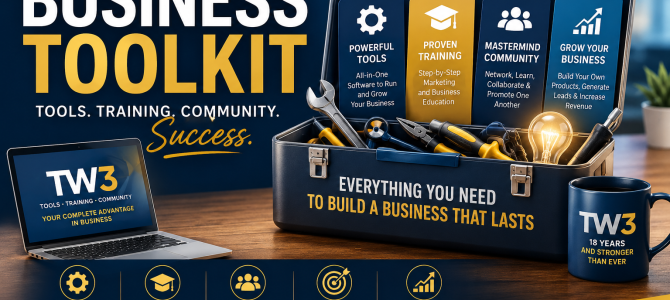
The Complete Business Toolkit: Why the Right Tools, Training, and Community Can Change Everything Success in business rarely comes from one great idea. More often, it comes from having the right combination of tools, proven training, experienced mentors, and a community that helps you keep moving forward. Too many entrepreneurs…
The Principles That Outlasted Every Recession, Every Technology Shift, and Every Trend
What began during the financial crisis of 2008 has survived the Great Recession, healthcare reform, dramatic shifts in digital marketing, COVID-19, and now the rise of Artificial Intelligence.
Not because we guessed what technology would come next…
But because we learned principles that never change.
“The entrepreneur who understands principles can use any tool.
The entrepreneur who only understands tools is limited to whatever happens to be popular today.”
— Terry Wilson, Episode 683
In This Anniversary Special
✔ The story behind how TW3 was born during the Great Recession
✔ Why technology has never been the foundation of our business
✔ Lessons learned surviving the Affordable Care Act, COVID, and Artificial Intelligence
✔ The surprising insight from the Book of Romans that perfectly explains business longevity
✔ Why principles always outperform platforms
✔ Looking back at memorable guests and eighteen years of podcasting
✔ An interview with Laurie Brown, winner of the TW3 Product Challenge, and creator of Lead Forge
TW3 Through the Years
Year
Milestone
2008
TW3 launches during the Great Recession.
2010–2012
Expansion into online coaching, WordPress marketing systems, and CRM technology.
2013–2016
Affordable Care Act reshapes insurance industry while TW3 expands into broader small business coaching.
2017–2019
Podcast continues to grow with entrepreneurs, authors, musicians, and business leaders joining the show.
2020
COVID accelerates digital transformation and reinforces the importance of adaptable business systems.
2023–2025
Automation, AI, and intelligent marketing systems become core parts of the TW3 platform.
2026
Episode 683 celebrates 18 years with the Product Challenge and the launch of Laurie Brown’s Lead Forge.
18 Years of TW3: The Principles That Outlasted Every Recession, Every Technology Shift, and Every Trend
Episode 683 of the TerryWilson3.com Podcast is unlike any episode we’ve ever released.
Yes, it’s an interview with Laurie Brown, winner of the recent TW3 Product Challenge and creator of Lead Forge, an innovative marketing solution designed to help small businesses improve their social media presence while monitoring how they compare to their competitors in local search.
But this episode is about something even bigger.
It’s about celebrating 18 years of TW3.
When I stop and think about that number, it’s honestly hard to believe.
Eighteen years.
Thousands of coaching sessions.
Thousands of business owners served.
Hundreds of podcast interviews.
More than 680 podcast episodes.
Countless software updates.
Entire industries transformed.
Economic recessions.
A global pandemic.
Artificial Intelligence.
And somehow… we’re still here.
Not only are we still here—we’re stronger than we’ve ever been.
People often ask me, “Terry, how has TW3 survived while so many companies have disappeared?”
The answer surprised even me.
I don’t think it has anything to do with software.
I think it has everything to do with principles.
TW3 Was Born During One of America’s Hardest Economic Seasons
When TW3 was founded in 2008, the economy wasn’t exactly encouraging entrepreneurship.
Banks were collapsing.
The housing market had imploded.
Businesses were closing.
People were losing jobs at a staggering pace.
The Great Recession wasn’t simply another economic downturn—it fundamentally changed the way many Americans viewed work, business ownership, and financial security.
For many people, it was a season of fear.
For me, it became a season of necessity.
I wasn’t trying to build some revolutionary software company.
I was trying to answer a simple question:
“How do ordinary people consistently find customers regardless of what’s happening in the economy?”
That question has never changed.
Everything else has.
The Software Changed. The Mission Never Did.
If someone discovered TW3 today, they would likely assume we’ve always been an AI-powered business platform.
Nothing could be further from the truth.
The earliest versions of TW3 looked nothing like today’s platform.
We built on WordPress.
We connected third-party dialers.
We experimented with CRMs that no longer exist.
We used autoresponders that have long since disappeared.
Entire technologies have come and gone over the past eighteen years.
Meanwhile, our mission never changed.
We have always focused on helping business owners accomplish three things:
Find people who need what they offer.
Create a repeatable system to qualify those people.
Present a solution that genuinely improves someone’s life.
That’s it.
Everything else is simply the vehicle.
Markets Change. Human Nature Doesn’t.
Over the past eighteen years, I’ve watched entrepreneurs chase every shiny object imaginable.
One year everyone believed Facebook was the answer.
Then it was YouTube.
Then Instagram.
Funnels.
Chatbots.
TikTok.
Artificial Intelligence.
Every few years someone confidently announces:
“This changes everything.”
Sometimes it does.
But not in the way people think.
The tools change.
The principles rarely do.
People still buy from businesses they trust.
People still respond to businesses that solve real problems.
People still appreciate authenticity.
People still need conversations before making significant decisions.
Technology simply changes how those conversations begin.
That’s why our philosophy has remained remarkably consistent while the software around it has continually evolved.
The Affordable Care Act Changed My Industry Overnight
As many listeners know, my professional background is in the insurance industry.
When the Affordable Care Act became law, many agents found themselves trying to navigate an entirely new landscape.
Products changed.
Compensation changed.
Consumer expectations changed.
Entire business models disappeared almost overnight.
Many professionals understandably became discouraged.
Others simply left the industry.
But the core business principles remained exactly the same.
People still needed guidance.
Families still needed protection.
Business owners still needed someone they trusted.
Instead of mourning what had changed, we asked a better question:
“How do we serve people using the new tools now available?”
That single mindset has guided nearly every major decision we’ve made since.
COVID Didn’t Kill Businesses. It Exposed Them.
Then came COVID.
No one saw it coming.
Practically overnight, offices emptied.
Face-to-face appointments stopped.
Conferences disappeared.
Networking groups paused.
Entire industries were forced online.
Many businesses struggled—not because they lacked talent—but because they lacked systems.
Businesses that depended upon one way of selling suddenly found themselves with no way to sell.
Businesses built upon adaptable systems pivoted much faster.
That’s one of the reasons we’ve spent years teaching business owners to build systems rather than depend upon personalities, locations, or individual platforms.
Systems survive disruption.
People who understand principles adapt faster than people who only understand procedures.
COVID simply proved that lesson on a global scale.
Then Came Artificial Intelligence
Today, AI dominates nearly every business conversation.
Some people are excited.
Others are terrified.
Personally?
I see AI the same way I saw websites in the early 2000s, social media in the 2010s, and marketing automation in the years that followed.
It’s another incredibly powerful tool.
But it’s still only a tool.
AI doesn’t replace understanding.
It amplifies it.
If your business strategy is weak, AI helps you execute weak strategies faster.
If your systems are strong, AI helps you scale them more efficiently.
The technology isn’t the competitive advantage.
The thinking behind how you use it is.
That’s why TW3 continues to invest heavily in teaching principles first and technology second.
Technology will continue changing.
Good business thinking never goes out of style.
Continue reading below as we explore the surprising lesson from the Book of Romans that perfectly explains why TW3 has survived eighteen years—and why understanding principles will always outperform simply memorizing techniques.
The Lesson That Changed How I See Business Forever
Just a few evenings before recording this episode, I was teaching through the Book of Romans during our Bible study.
As often happens when you’re studying Scripture carefully, something clicked.
It wasn’t a new verse.
It wasn’t a new doctrine.
It was a new way of connecting something I’d believed for years but had never fully articulated.
One of the greatest gifts a pastor, teacher, or mentor can give someone isn’t simply telling them what the Bible means.
It’s teaching them how to study the Bible for themselves.
There’s a tremendous difference.
When someone only knows what another person says about Scripture, they’re forever dependent upon that teacher.
But when they learn how to read the text, observe it, compare Scripture with Scripture, understand context, and think critically, they become free.
They’re no longer borrowing someone else’s understanding.
They’re developing their own.
That realization stopped me in my tracks.
Because I suddenly realized…
That’s exactly what we’ve been doing at TW3 for eighteen years.
We’ve Never Really Been Selling Software
I know that sounds strange coming from someone whose business includes CRM software, automation, AI, websites, voice agents, lead generation systems, and business technology.
But if you look closely, the software has never actually been the product.
The software has always been the vehicle.
The real product has been understanding.
We’ve tried to teach business owners how business works instead of simply telling them which buttons to click.
Because buttons change.
Software changes.
Platforms come and go.
Principles endure.
When you understand why a business grows, you can adapt to whatever technology comes next.
The Carpenter Isn’t Great Because of His Hammer
I often think about a master carpenter.
No one hires a carpenter because he owns a certain brand of hammer.
They hire him because he knows what to build.
If his hammer breaks, he doesn’t lose his livelihood.
He buys another hammer.
The skill was never in the tool.
The skill was in the craftsman.
Business works the same way.
Too many entrepreneurs become emotionally attached to software.
One CRM.
One social media platform.
One marketing tactic.
One AI application.
But if your entire business depends upon one tool, your business becomes fragile.
If, instead, your business depends upon timeless principles, every new tool simply becomes another opportunity.
That’s why TW3 has evolved from WordPress websites and third-party dialers to today’s AI-powered ecosystem without losing its identity.
The hammer changed.
The carpenter didn’t.
The Three Things Every Business Must Master
When I look back over the last eighteen years, I can simplify everything we’ve ever taught into three ideas.
Find people who need your help.
Create a repeatable process that qualifies those people.
Offer a solution you genuinely believe improves their lives.
Every version of TW3 has been built around those three ideas.
Whether we were making phone calls from a simple WordPress site…
Building lead funnels…
Teaching social media marketing…
Creating AI assistants…
Or deploying intelligent voice agents…
The objective has remained exactly the same.
Find.
Qualify.
Serve.
Everything else is simply delivery.
Eighteen Years of Conversations That Changed Lives
One of the things I’m most grateful for over these eighteen years is the opportunity to sit down with incredible people whose stories have challenged, encouraged, and inspired our audience.
Our podcast has never been about interviewing celebrities for the sake of celebrity.
It’s been about discovering principles that listeners can immediately apply to their own businesses and lives.
As both a lifelong Chicago fan and a musician, that conversation meant a great deal to me personally. But what made the interview truly memorable wasn’t simply talking music—it was hearing Bill describe the discipline, preparation, persistence, and craftsmanship required to build a career spanning decades. Those same qualities apply whether you’re writing songs, leading a company, or serving customers every day. :contentReference[oaicite:1]{index=1}
We’ve also had the privilege of sitting down with authors, coaches, entrepreneurs, educators, business leaders, and innovators from a wide variety of industries.
Each guest reinforced the same lesson:
Success leaves principles long before it leaves techniques.
The Conversation Has Continued to Evolve
One of the things I’m most proud of is that this podcast has grown right alongside the business community it serves.
In recent months we’ve explored topics such as:
Why every business should create its own unique product or service.
Why understanding why you’re succeeding matters more than simply knowing that you’re succeeding.
How building a business around your personality, passions, and strengths creates sustainable success.
Why your personal story may be your greatest marketing asset.
If you haven’t heard them yet, I encourage you to go back and listen to:
Episode 681 — Why Every Business Should Create Its Own Product or Service.
Episode 682 — It’s Not “How Are You Doing?” It’s “Why Are You Doing as Well as You Are?”
Although the subjects vary, they all point back to one foundational truth:
Business growth begins with personal growth.
People who invest in their thinking consistently outperform people who merely chase the latest trend.
The Next Generation of TW3
As we celebrate eighteen years, I don’t believe we’re reaching the finish line.
I honestly believe we’re just getting started.
Artificial Intelligence is changing how businesses communicate.
Automation is changing how businesses operate.
Digital marketing continues to evolve almost daily.
But those changes don’t intimidate me.
They excite me.
Because every advancement creates another opportunity to apply timeless business principles in fresh ways.
Our mission remains exactly what it was in 2008:
Help ordinary people build extraordinary businesses by understanding principles that never become obsolete.
Laurie Brown’s Story Is the Perfect Picture of What TW3 Has Always Been About
As we looked for a way to celebrate TW3’s eighteenth anniversary, we wanted to do more than simply look backward.
We wanted to demonstrate what the future looks like.
That’s why we challenged our Elite members to do something many business owners never attempt.
Create your own product.
Not just another service.
Not another sales pitch.
A real product that solves a real problem.
The response exceeded every expectation.
Our members created software, marketing systems, lead generation tools, educational resources, and business solutions that reflected their own experiences and passions.
But one product consistently rose to the top.
Lead Forge.
Created by Laurie Brown—known affectionately throughout our community as Miss Spelling Bee—Lead Forge embodies exactly what we’ve spent eighteen years teaching.
Laurie didn’t simply learn how to click buttons inside software.
She learned how to identify a business problem, build a repeatable solution, and package it into something that creates value for other business owners.
Lead Forge helps small businesses consistently publish social media content while giving them insight into how they compare with competitors in local online search.
In other words, it helps businesses become more visible where today’s customers are already looking.
That’s not just software.
That’s solving a problem.
And businesses that solve meaningful problems rarely struggle to find customers.
Innovation Isn’t Reserved for Silicon Valley
One of the biggest myths entrepreneurs believe is that innovation belongs to large corporations with massive research budgets.
I simply don’t believe that’s true.
Some of the best business ideas I’ve ever seen have come from ordinary people who became frustrated enough with an everyday problem to finally build a solution.
That’s exactly what happened during our Product Challenge.
Members who had never considered themselves “software developers” suddenly realized they could create tools that genuinely help people.
They discovered something important.
You don’t have to invent the next billion-dollar company.
You simply need to solve a problem better than it’s being solved today.
That’s entrepreneurship.
That’s innovation.
And that’s exactly what Laurie accomplished.
Eighteen Years Later, Our Mission Is Still the Same
If you’ve followed TW3 for any length of time, you’ve probably noticed something.
The software has changed dramatically.
Our website has changed.
Our logo has evolved.
Our training has expanded.
Artificial Intelligence has become part of our daily workflow.
Voice agents now book appointments.
Automation handles tasks that once required hours of manual effort.
But our mission?
It hasn’t changed one bit.
We still exist to help ordinary people build extraordinary businesses.
We still believe that relationships outperform transactions.
We still believe that education creates freedom.
We still believe that understanding principles is more valuable than memorizing procedures.
And perhaps most importantly…
We still believe every business owner deserves access to world-class tools, coaching, and encouragement regardless of where they’re starting.
If You’re New to TW3, Here Are a Few Episodes to Start With
If Episode 683 is your introduction to the TW3 Podcast, I’d encourage you to explore some of the conversations that have helped shape our community over the years.
Episode 636 – Who Are You?
A powerful discussion on self-awareness, leadership, and building a business that reflects your values. :contentReference[oaicite:2]{index=2}
Episode 665 – When You Don’t Get the Trumpet
A deeply personal reminder that life’s unexpected detours often become our greatest opportunities. :contentReference[oaicite:4]{index=4}
Each episode explores different subjects, but they all point toward the same timeless truth:
Success isn’t accidental.
It’s built through intentional growth, consistent learning, meaningful relationships, and the willingness to adapt while holding firmly to timeless principles.
Thank You for Eighteen Incredible Years
There are very few businesses that have the privilege of serving people for nearly two decades.
I don’t take that lightly.
Whether you’ve been with us since 2008…
Joined during the pandemic…
Found us through artificial intelligence…
Or discovered this podcast just this week…
Thank you.
Thank you for trusting us.
Thank you for believing in this mission.
Thank you for allowing me to do something I genuinely love.
For eighteen years, I’ve had the privilege of helping entrepreneurs discover something bigger than business.
Purpose.
Confidence.
Freedom.
And the realization that success isn’t reserved for a select few.
It’s available to ordinary people who consistently apply extraordinary principles.
As we celebrate this milestone, I’m more excited about the future than I’ve ever been.
Artificial Intelligence will continue evolving.
Marketing will continue changing.
New technologies will emerge.
New opportunities will appear.
And TW3 will continue doing what we’ve always done:
Helping businesses find more people.
Helping businesses build repeatable systems.
Helping businesses solve meaningful problems.
Those principles have carried us through the Great Recession.
They carried us through industry disruption.
They carried us through COVID.
They’ll carry us through the AI revolution as well.
Because principles outlive platforms.
Understanding outlasts technology.
And businesses built on solid foundations have a remarkable way of standing long after trends have faded.
Ready to Build a Business That Lasts?
If today’s episode encouraged you, we’d love to help you take the next step.
Whether you’re starting your first business, looking to automate an existing company, or wanting practical coaching to help you grow, TW3 has the tools, training, and community to help you succeed.
Explore our resources:
What Eighteen Years Have Taught Me
If I had to summarize everything I’ve learned into just a few thoughts, it would be these:
Relationships are more valuable than transactions.
Character compounds just like interest.
Customers don’t buy software—they buy confidence.
Technology should simplify people, not replace them.
The best marketing still begins with serving people well.
Your story is one of your greatest business assets.
Businesses built on principles survive trends.
Learning how to think will always outperform memorizing what to do.
The people you spend time with influence your habits, attitudes, faith, success, and even your future. Learn the fascinating scientific, psychological, and biblical reasons why choosing the right community can transform your life and business.